A few people know each system
Every plant has programs only one or two engineers can explain, and they are needed everywhere at once.
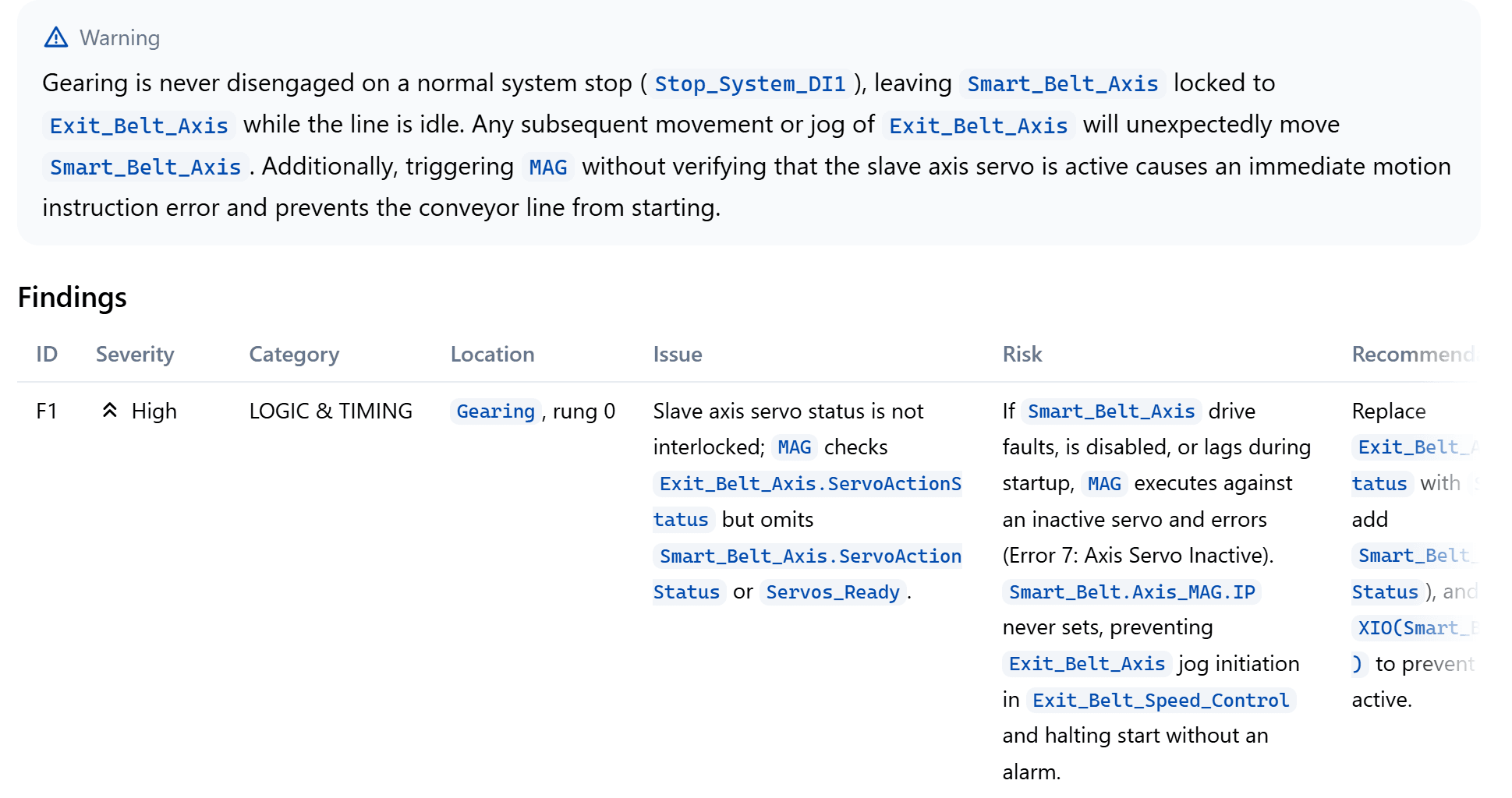
Answers with the evidence, for everyone on the team
#1 Generative AI Platform among the System Integrator Giants
Altitude is the AI engineer for system integrators, OEMs and manufacturers. It reads every PLC, robot, HMI and drawing across 43 platforms, answers with the evidence, and makes every change a redline your engineers approve.
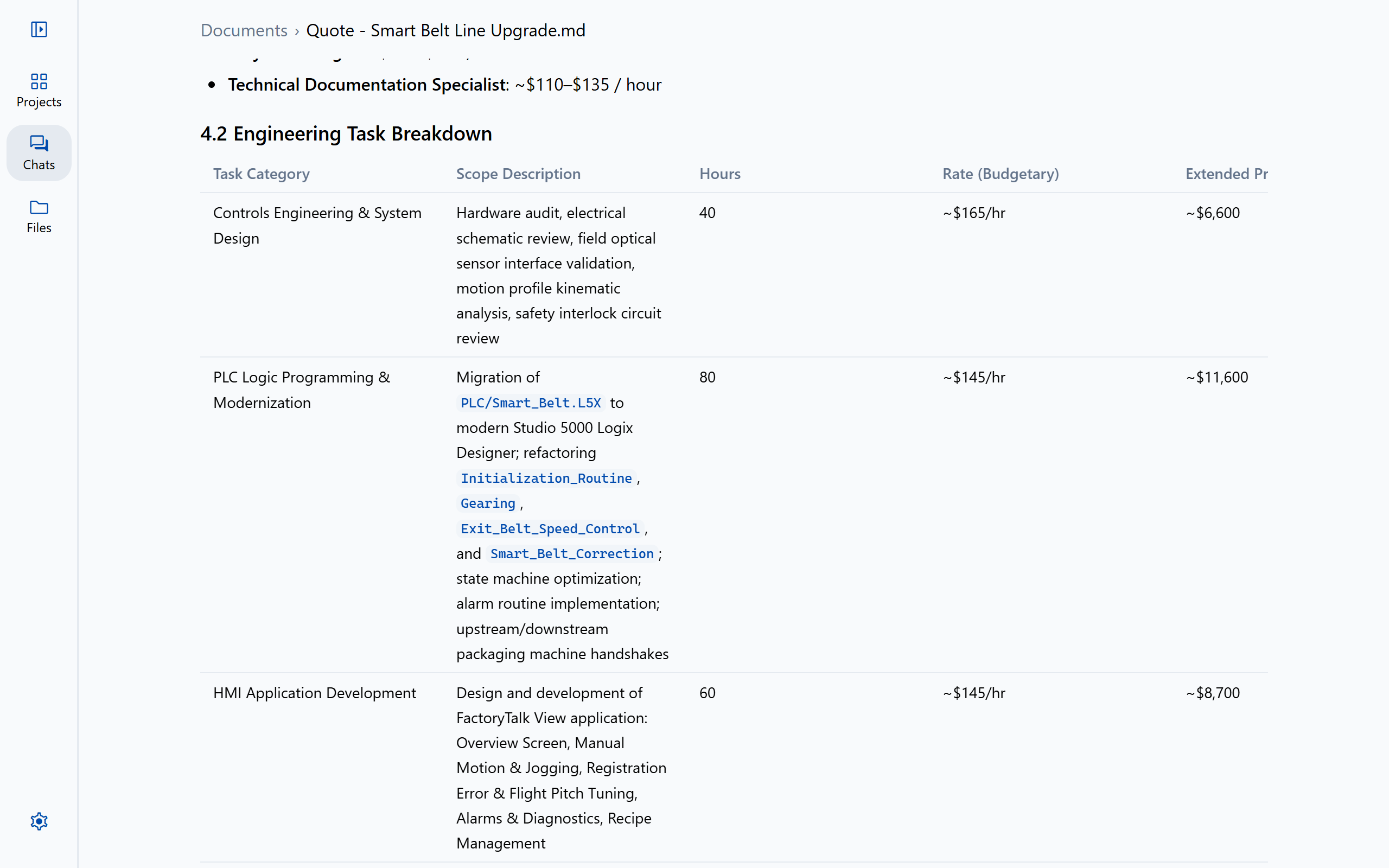
Write a quote for the Smart Belt upgrade from the customer spec.
From the first quote to the signed SAT
Works across 43 platforms
A proposal due the next day
$40M
in missing scope and instrumentation that Altitude flagged before the proposal went out, the day before it was due.
“The AI caught detail that my own team had for sure missed even after 2.5 weeks of manual work.”
Proposals
Why teams bring in Altitude
Altitude takes the reading, checking and writing off their desks, so every engineer on the team works with what only the most experienced used to know.
Every plant has programs only one or two engineers can explain, and they are needed everywhere at once.
Answers with the evidence, for everyone on the team
Specs, I/O lists, FATs, SATs and manuals take weeks, and they fall behind the code the day it changes.
Documents written from what you actually built
One line runs Rockwell, the next Siemens, and the cells hold robots from three brands with three languages.
One AI across every PLC, robot and HMI on the line
How it works
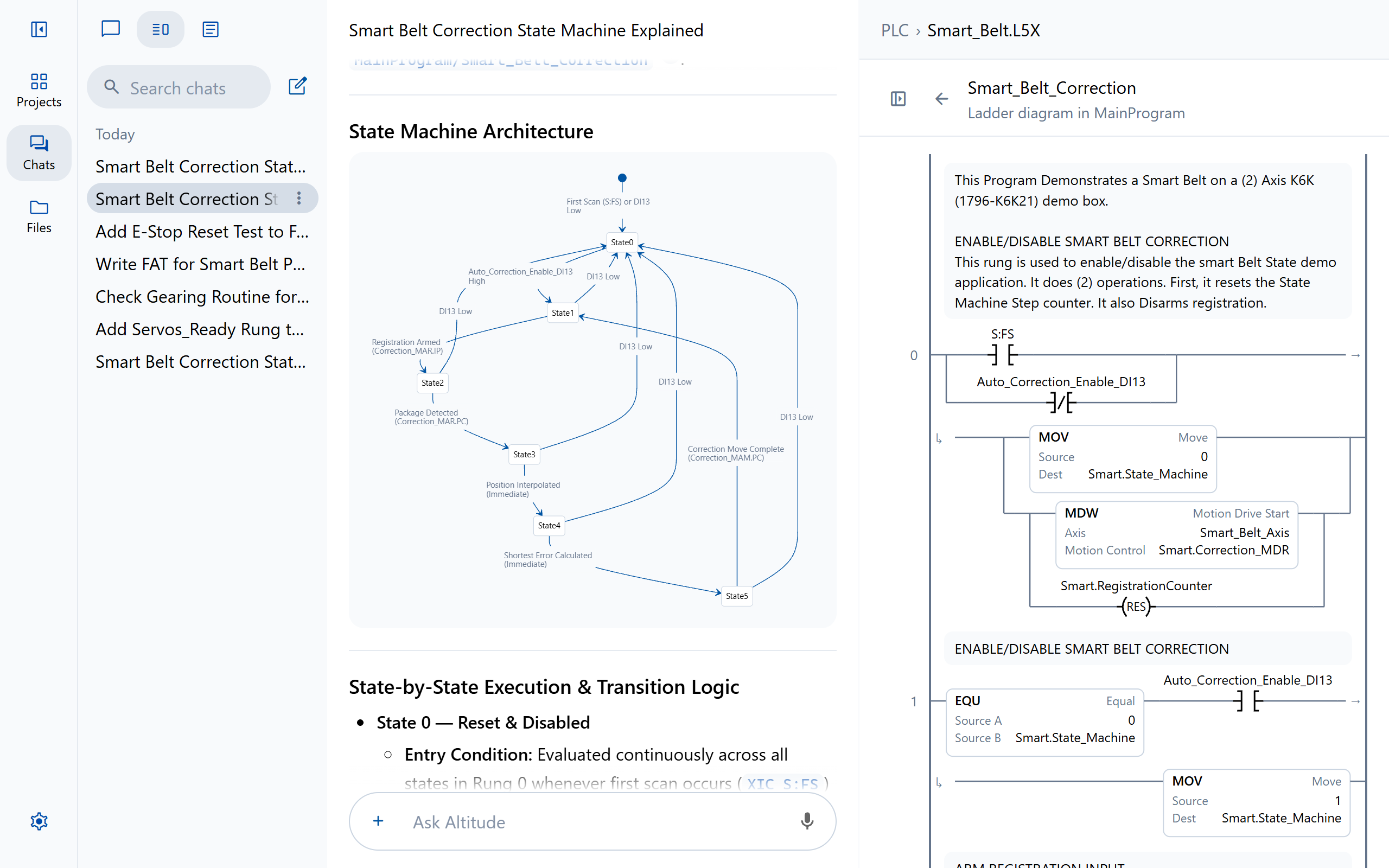
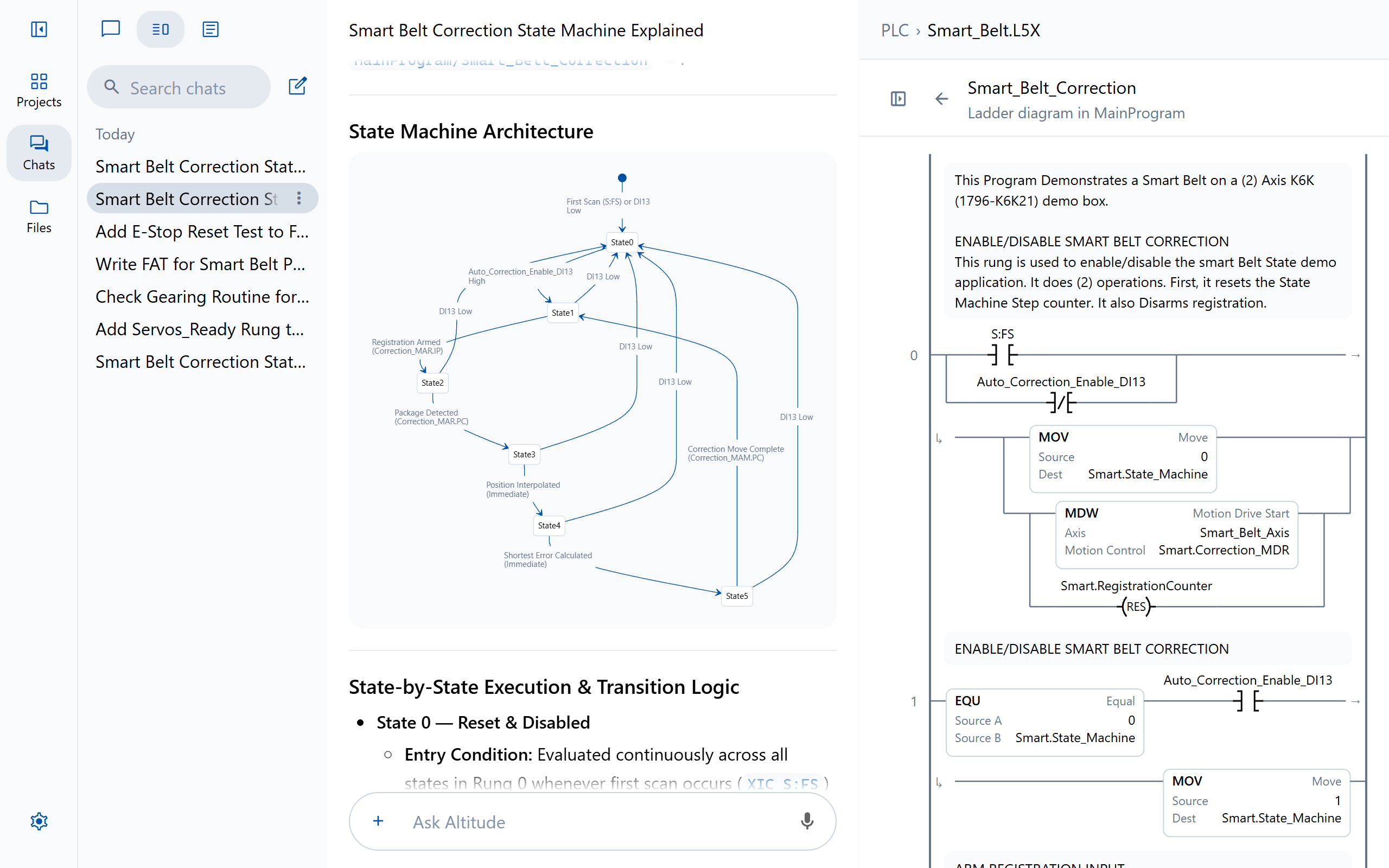
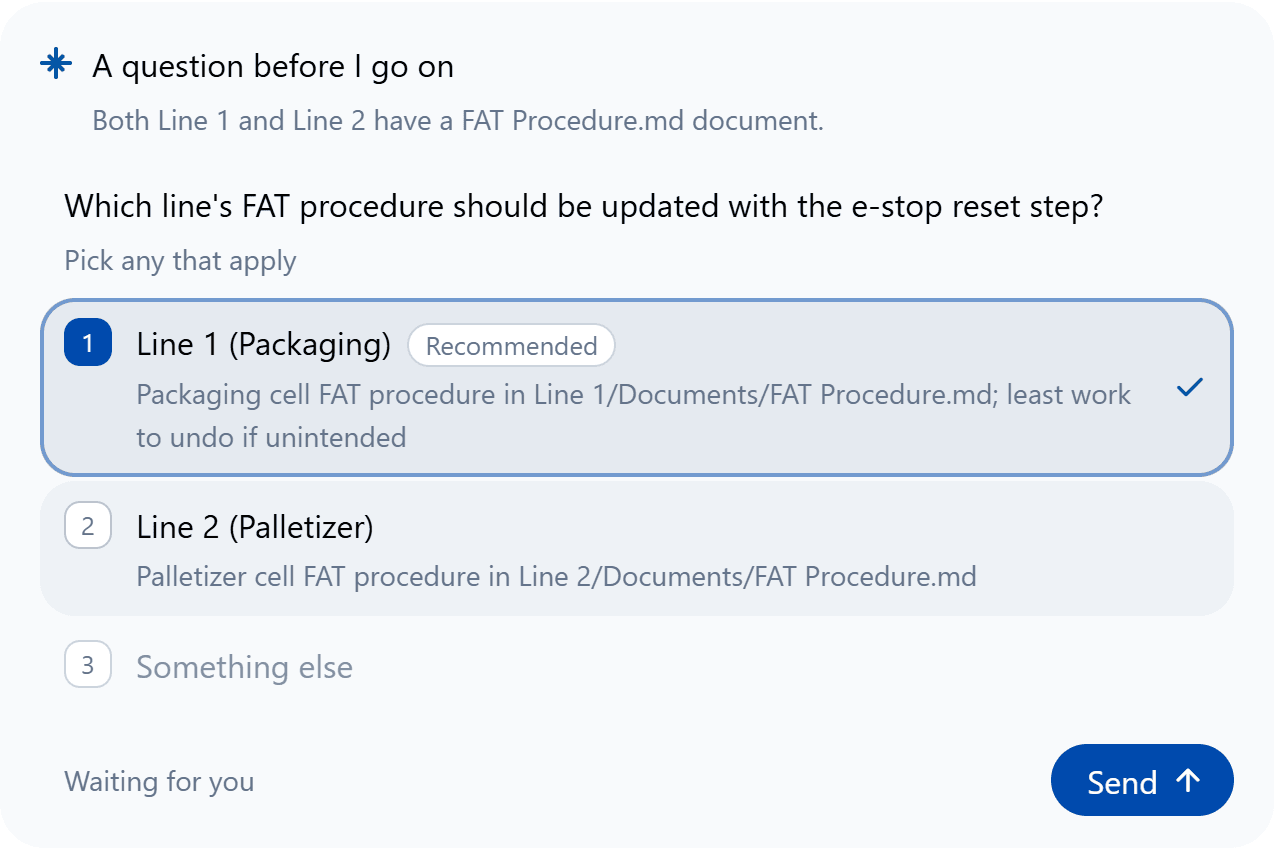
Ask about anything the project holds. A team of agents with hundreds of tools built for industrial automation reads, drafts, reviews, critiques and refines the work several times before you see it.
Repeated several times on every request. Not one model answering once.
What customers told us
Teams told us what their work took before Altitude and what it takes now. Across workflows, that adds up to a 30%+ increase in what a team can take on.
Project scope from a full drawing package
A quote built from customer requirements
Repetitive PLC code generation
Drawings to equipment sheets
Review every change
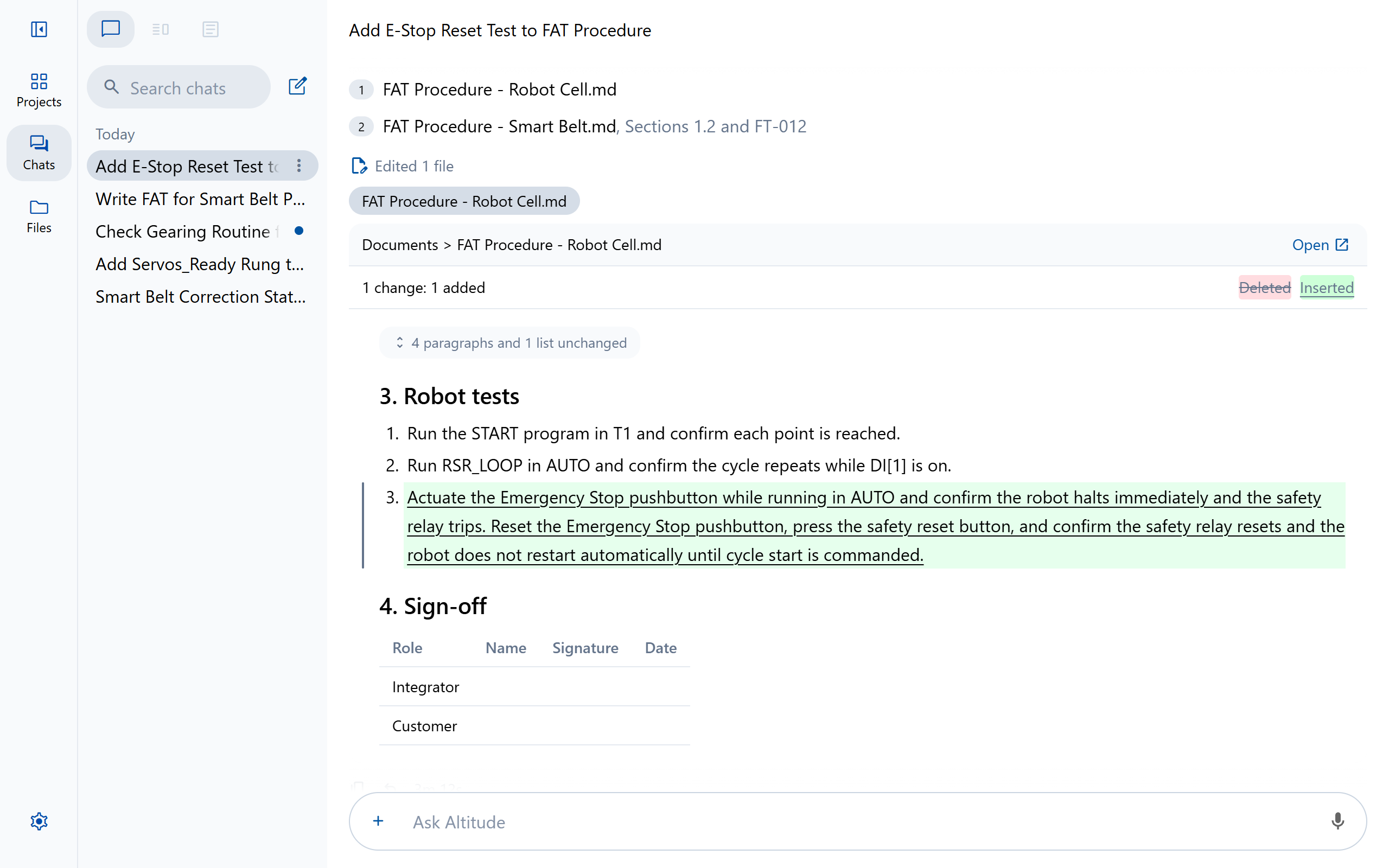
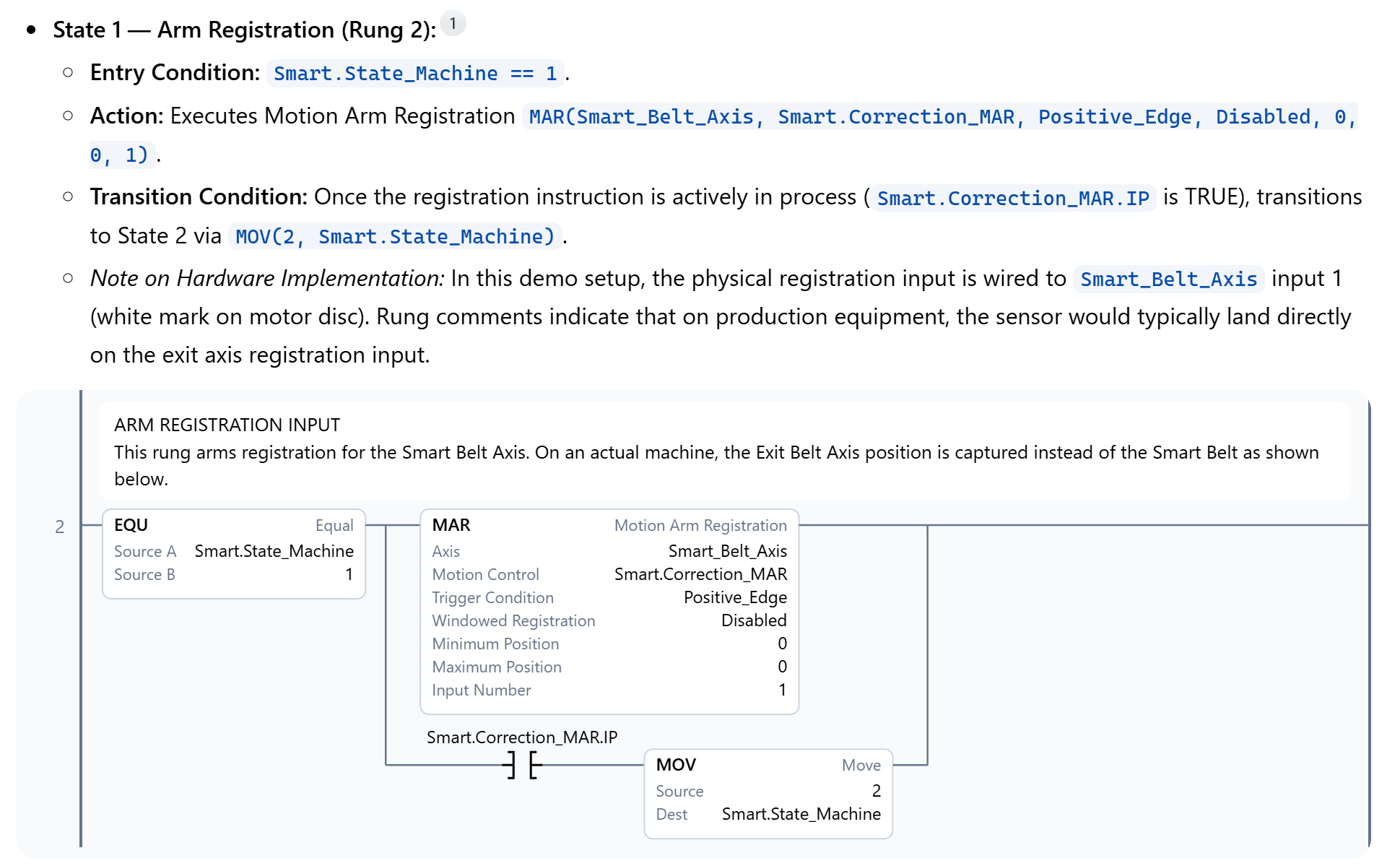
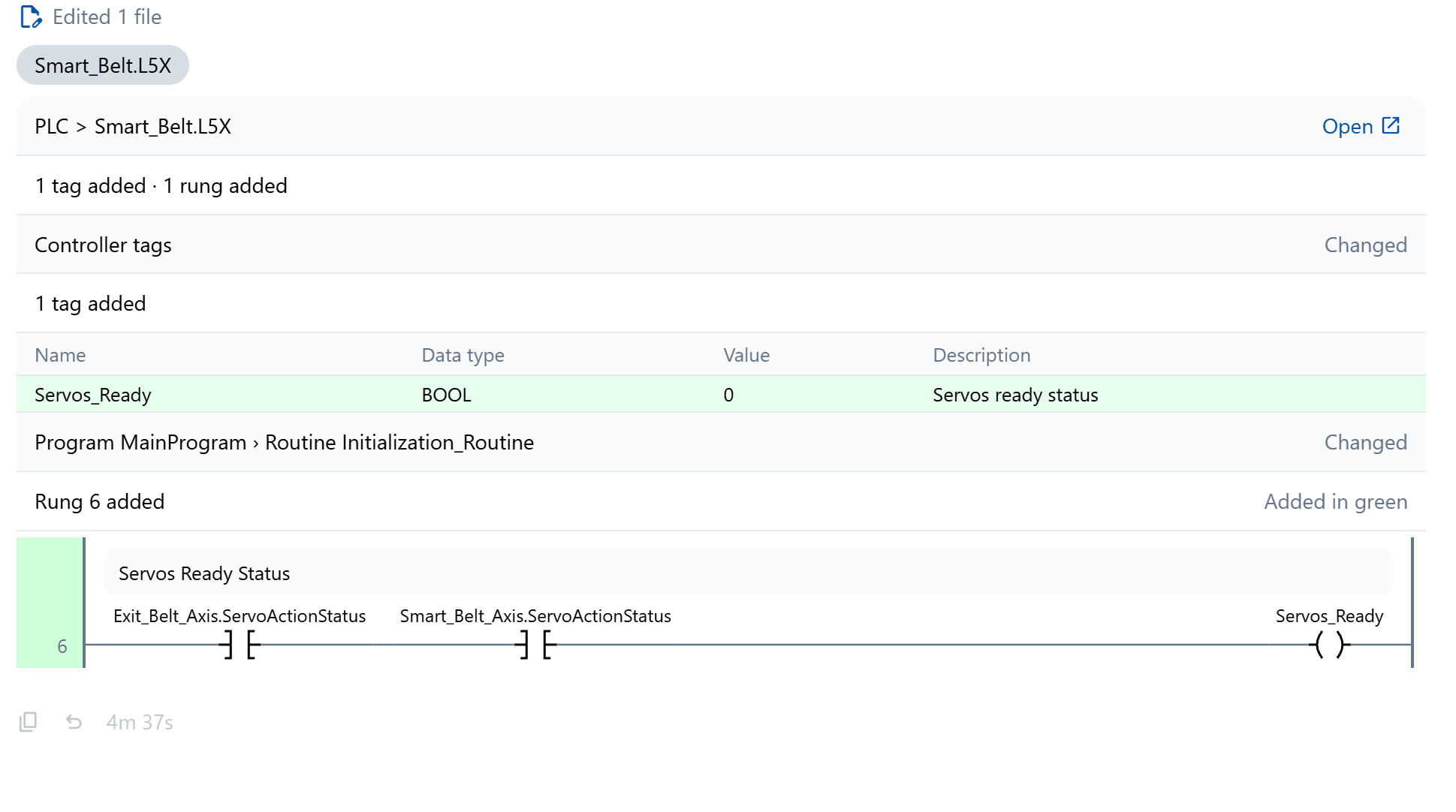
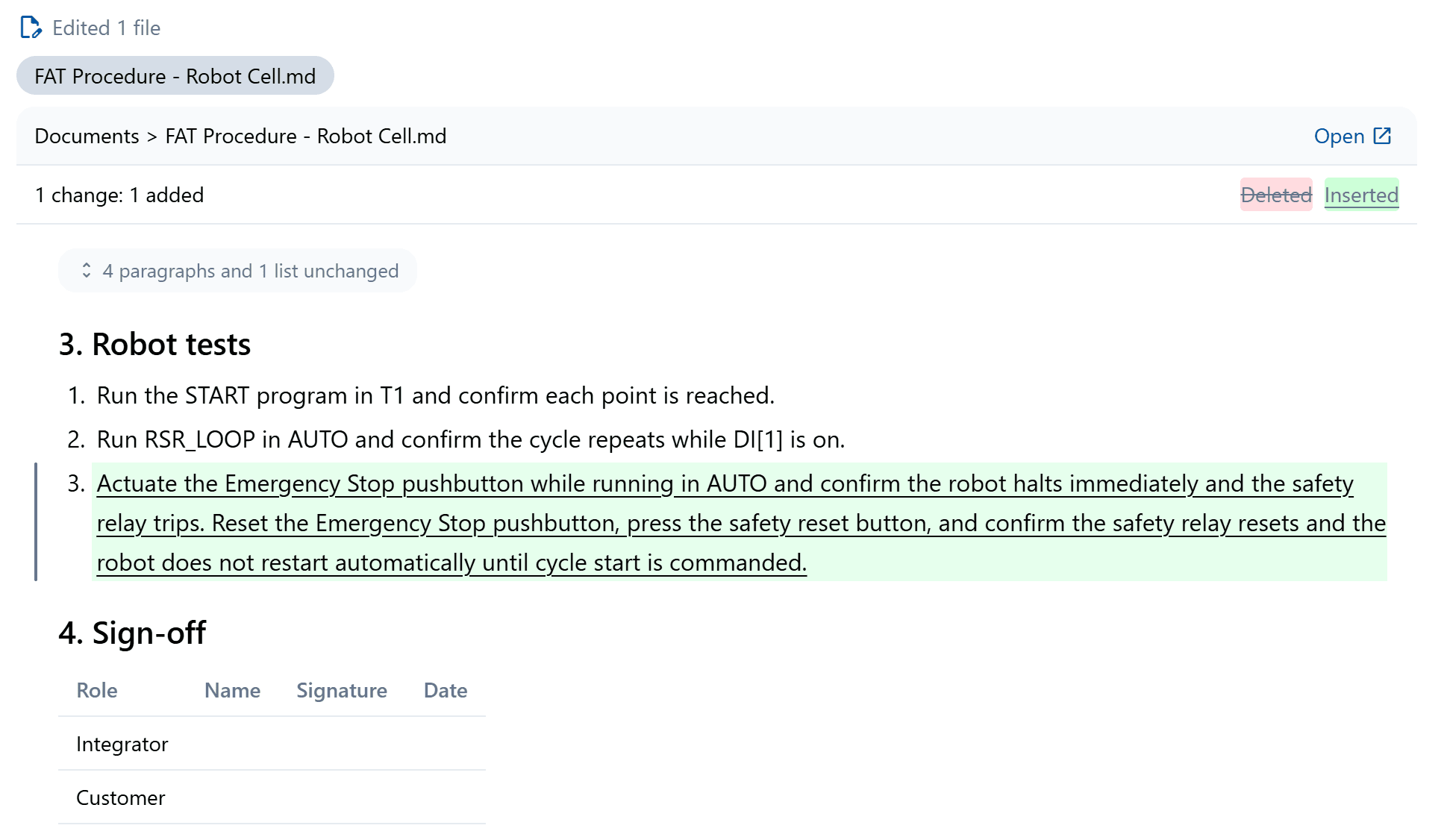
Altitude edits the project's own file and shows you exactly what moved, rung by rung, before anyone downloads it.
File History
Git underneath, nothing to learn on top. Every project keeps a full history on your server, and your engineers never commit, branch or merge.
Today
Approved by Priya Shah
In Line 4 PLC · Sam Rivera
Note: Tested on the FAT rig
Yesterday
Downloaded by Sam Rivera
Every request, upload, restore, rename and delete is a version, with who, when and the chat that asked for it.
Rungs for Studio 5000, objects for TIA Portal, each robot brand in its own view, and documents as redlines.
Rename, copy or restore approved contents and they stay approved. Any edit after needs approving again.
Every download recorded, a note of the version loaded on each PLC, and an approval record with each version’s SHA-256.
Migration and translation
Translate PLC programs between Studio 5000, TIA Portal and TwinCAT, bring legacy controllers onto current ones, and move robot programs between brands, with every decision written down.
Studio 5000 Infeed_Conveyor.L5X · Ladder
TIA Portal Infeed.scl · SCL
TwinCAT 3 Infeed.TcPOU · Structured text
Translation report
Coverage 3 of 3 rungs translated
Decision Jam_Timer.DN is read as the IEC timer’s Q output
Address map 7 tags mapped, names kept
FANUC PICK.LS · Teach pendant
ABB Pick.mod
KUKA Pick.src
URScript pick.script
One mapping for the whole project
P[2:Above_Pick] pAbovePick
DI[101:Case_Present] diCasePresent
DO[101:Gripper_Close] doGripperClose
Line 8: the wait’s TIMEOUT,LBL[90] branch is reported for review
One mapping for the whole project
P[2:Above_Pick] XABOVE_PICK
DI[101:Case_Present] $IN[101]
DO[101:Gripper_Close] $OUT[101]
Line 8: the wait’s TIMEOUT,LBL[90] branch is reported for review
One mapping for the whole project
P[2:Above_Pick] above_pick
DI[101:Case_Present] digital in 0
DO[101:Gripper_Close] digital out 0
Line 8: the wait’s TIMEOUT,LBL[90] branch is reported for review
The whole project
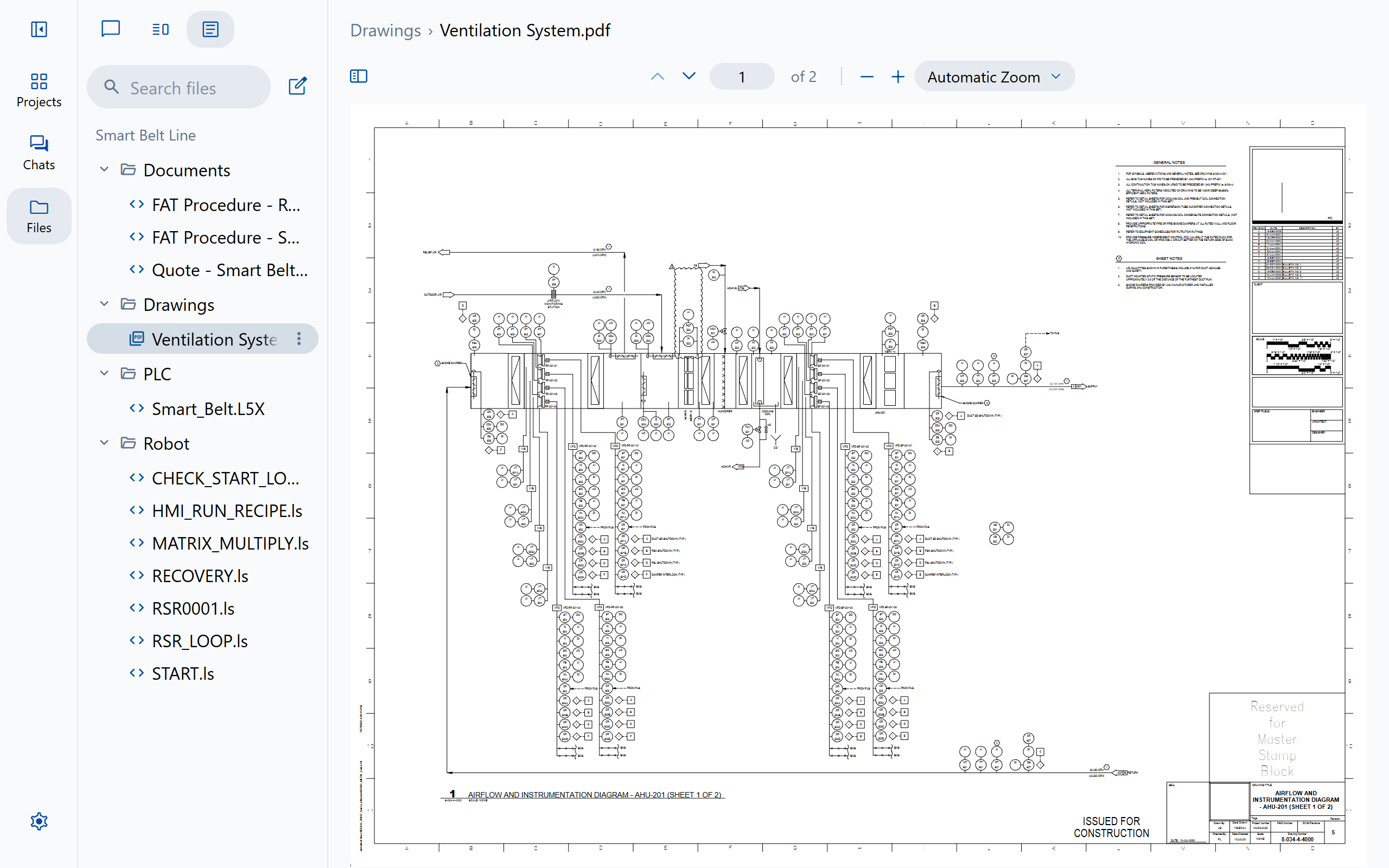
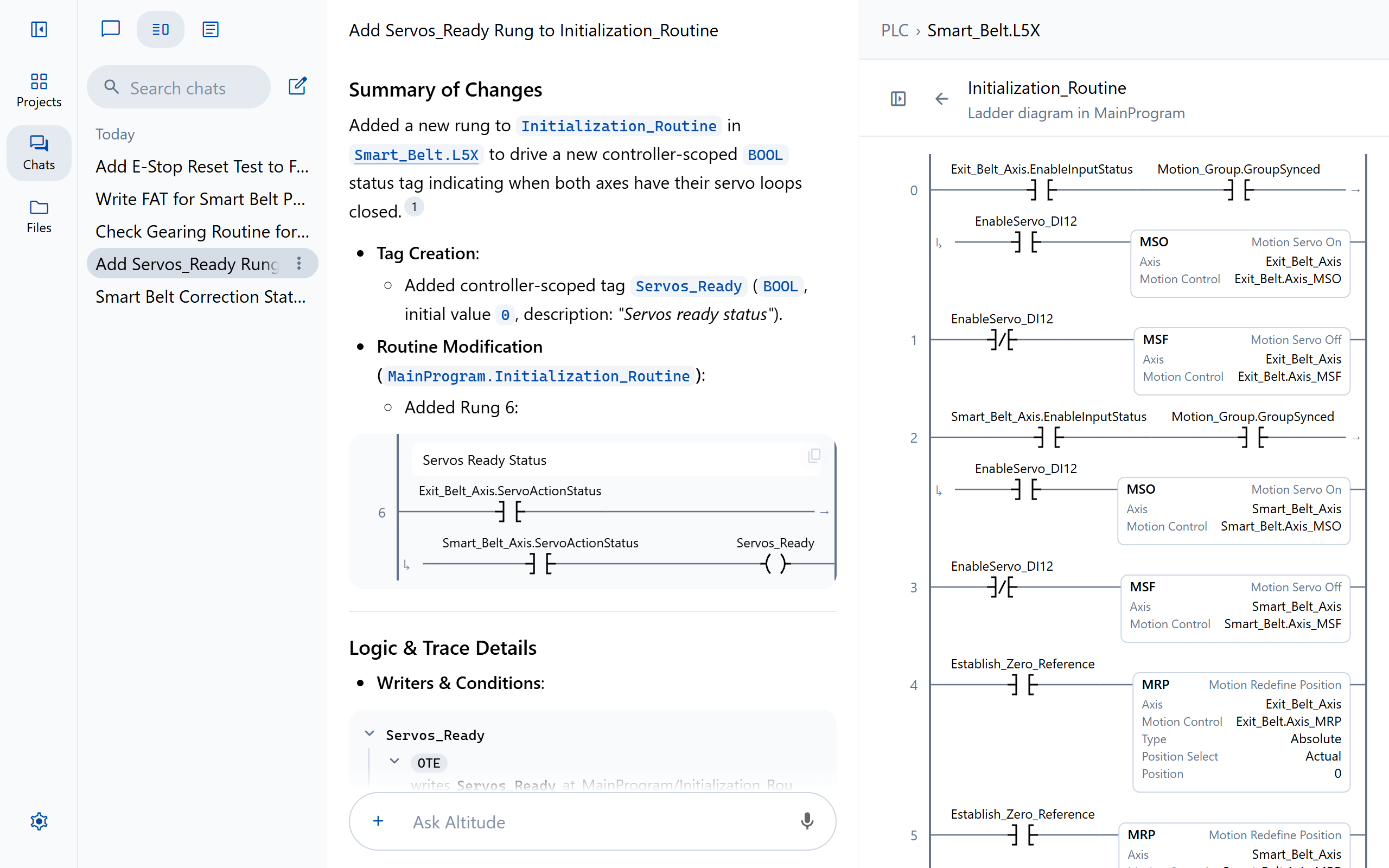
PLC programs, drawing sets, robot programs, HMI and SCADA exports and documents, together in one project, so an answer can follow a signal from the drawing to the rung.
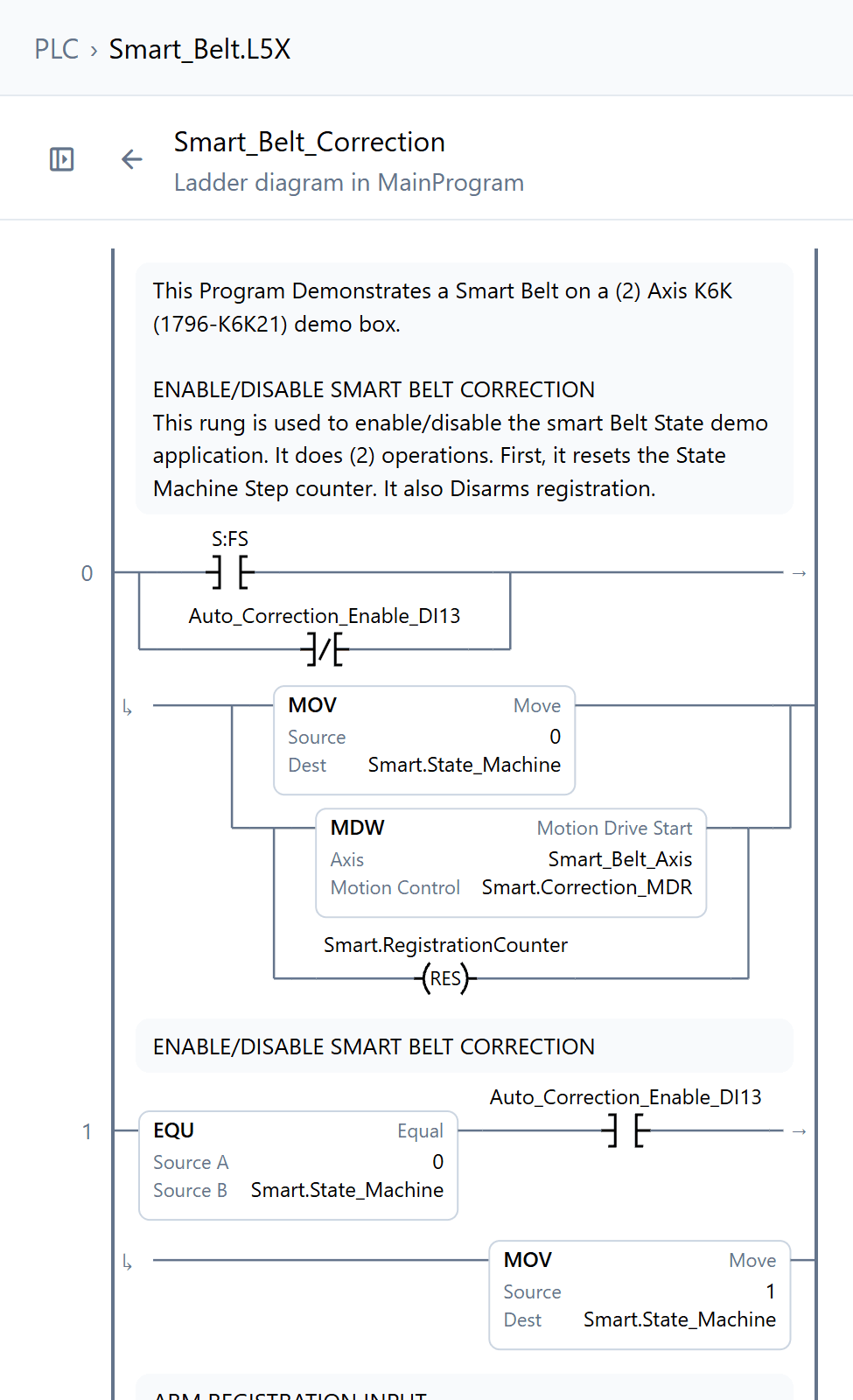
Studio 5000, TIA Portal and TwinCAT open the way your engineers know them, every rung drawn as ladder: ladder, structured text, function blocks, SFC, modules, alarms and safety.
Find errors across a whole package, extract I/O and instrument lists, and check them against the program.
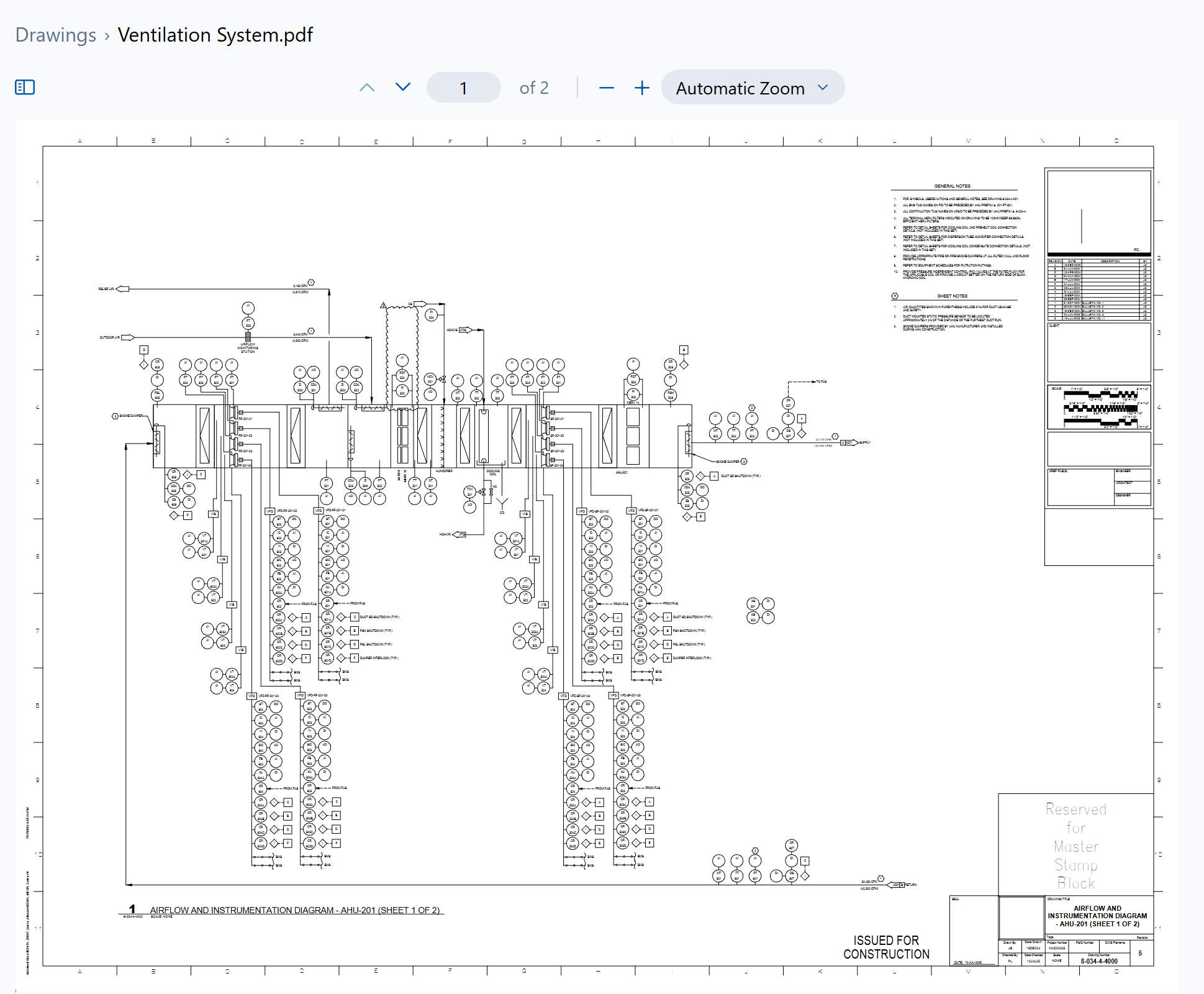
FANUC, ABB, KUKA, Yaskawa and 15 more brands, each in its own language, explained line by line, reviewed and edited.
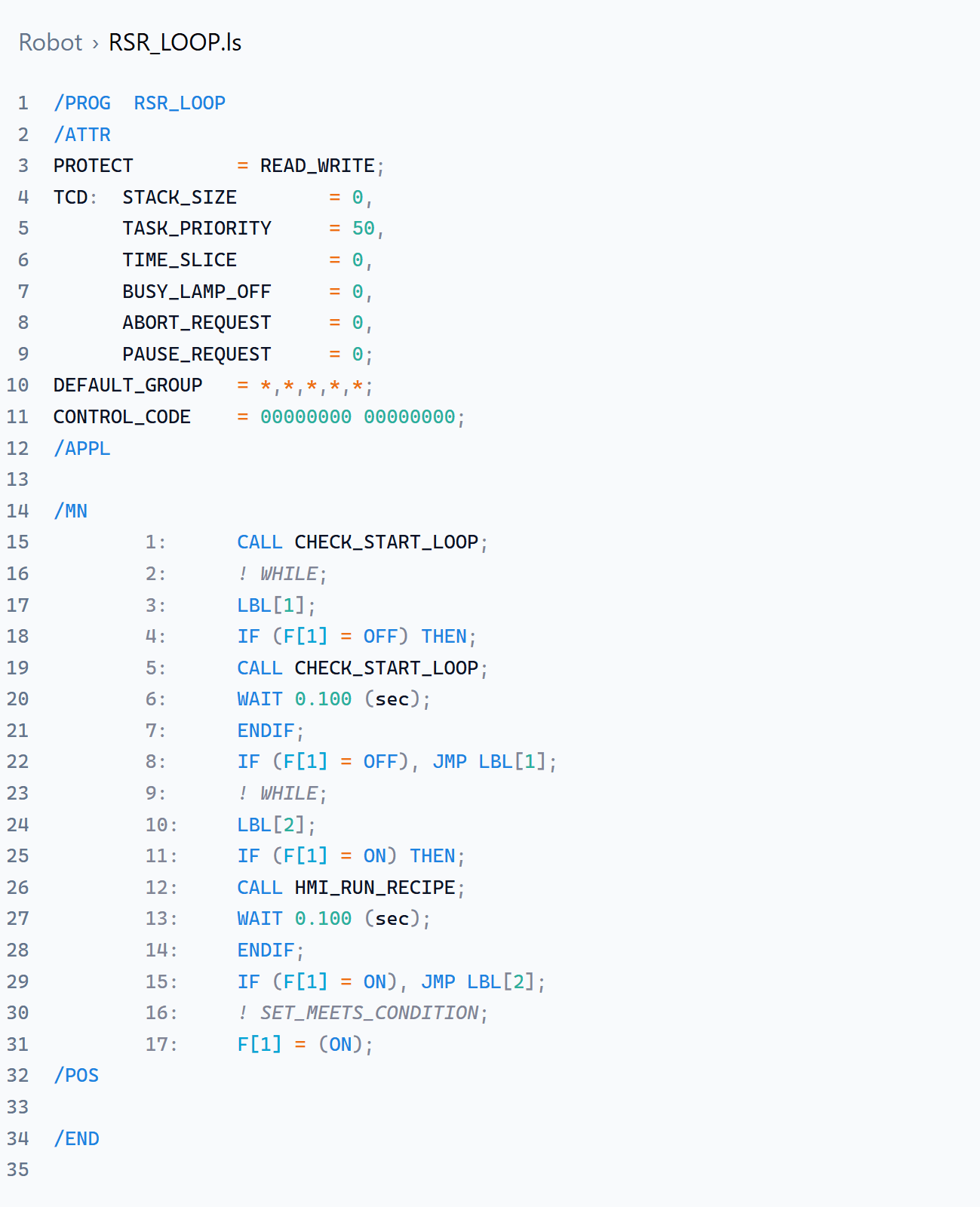
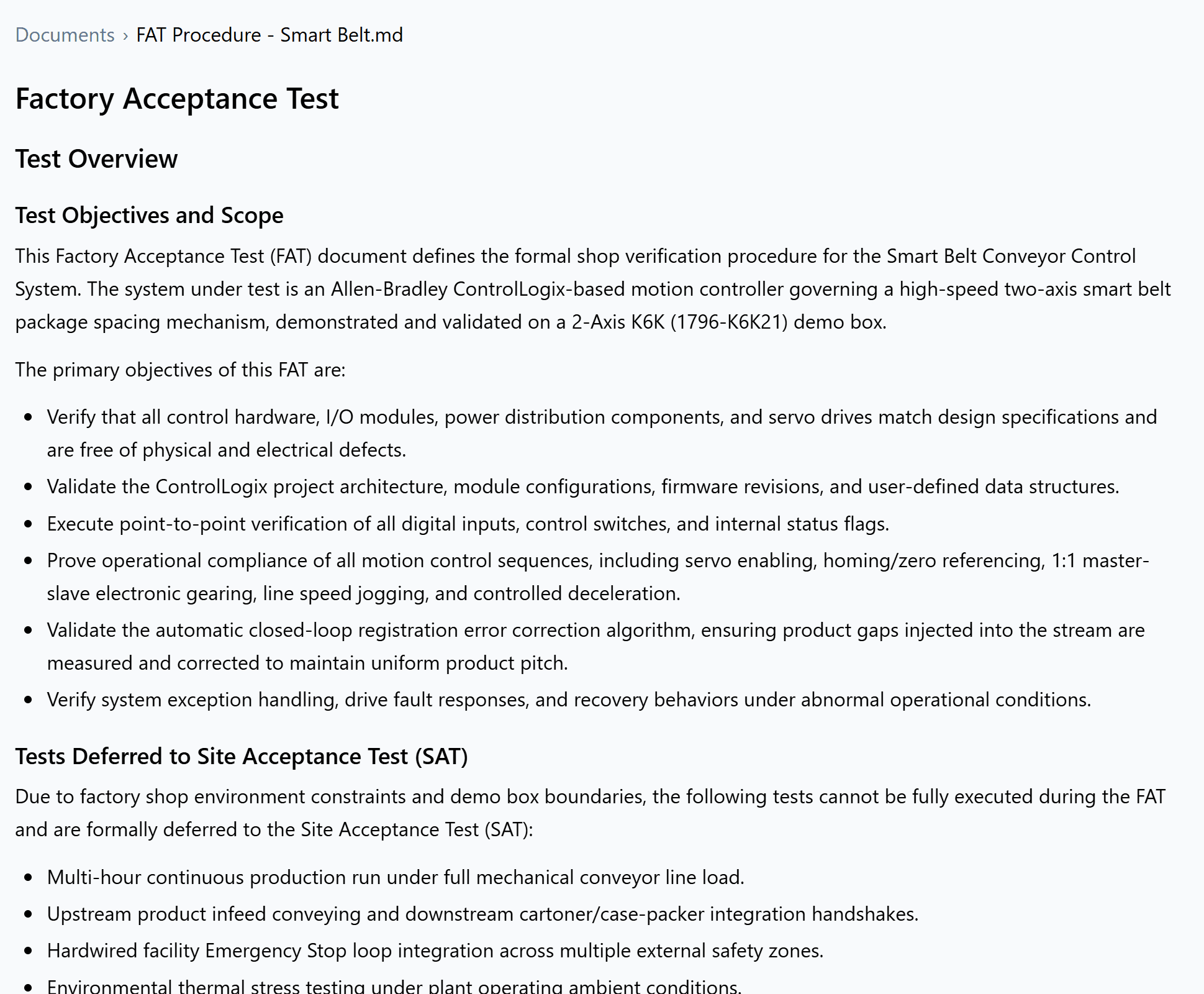
FATs, SATs, functional specs, manuals and I/O lists, written from what you actually built, on your own templates.
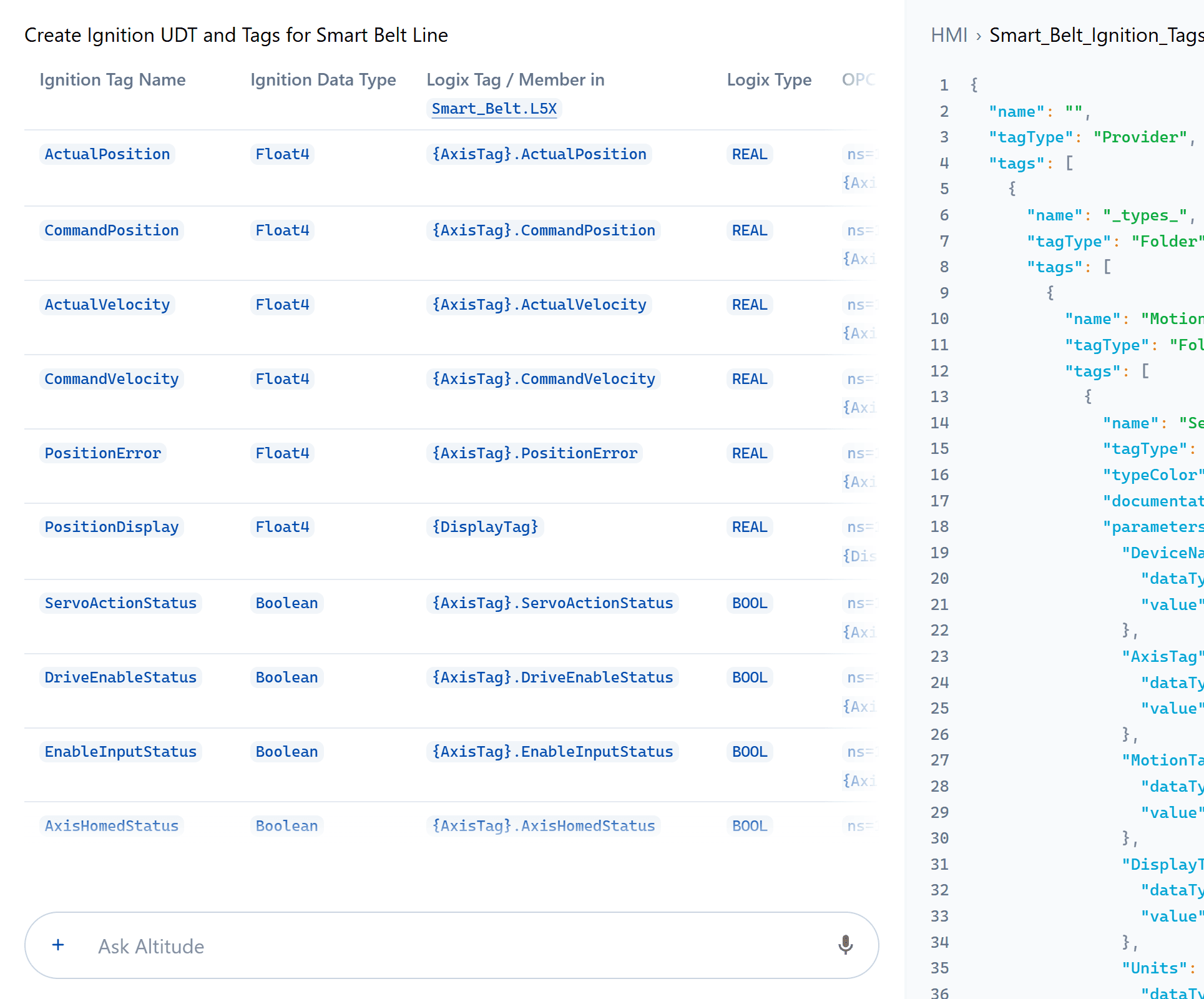
Ignition, FactoryTalk, AVEVA, WinCC and Proficy exports read beside the PLC, so tags, alarms and screens are checked against the logic.
Every vendor on the line
5 PLC platforms, 19 robot brands and 19 HMI and SCADA products, with the drawing packages and Word templates around them. The automation vendors' own assistants work inside their own tools. Altitude works across all of them.









;stroke:%23FFFFFF;stroke-width:0.25;stroke-miterlimit:1;}%20.st0{display:none;}%20.st1{display:inline;fill:none;}%20.st2{fill:%23FFFFFF;}%20.st3{fill:%23E50043;}%20.st4{fill:%23008E4F;}%20.st5{fill:%23008BD0;}%20.st6{fill:%23005EA8;}%20.st7{fill:%2393117E;}%20%3c/style%3e%3clinearGradient%20id='SVGID_1_'%20gradientUnits='userSpaceOnUse'%20x1='0'%20y1='400.8203'%20x2='0.7071'%20y2='400.1132'%3e%3cstop%20offset='0'%20style='stop-color:%231DA238'%3e%3c/stop%3e%3cstop%20offset='0.9831'%20style='stop-color:%2324391D'%3e%3c/stop%3e%3c/linearGradient%3e%3cg%20id='Nonprinting_x5F_frame'%20class='st0'%3e%3crect%20x='-11.3'%20y='-11.3'%20class='st1'%20width='337.3'%20height='423.5'%3e%3c/rect%3e%3c/g%3e%3cg%20id='Surface'%3e%3crect%20x='-5.7'%20y='-5.7'%20class='st2'%20width='294.8'%20height='412.1'%3e%3c/rect%3e%3c/g%3e%3cg%20id='ePlan'%3e%3cg%3e%3cg%3e%3cg%3e%3cpath%20class='st3'%20d='M283.4,0H0v218.1h283.5V0z%20M175.5,38.9L175.5,38.9l-55.3,151.7l0,0c-3.1,8.5-12.5,12.9-21.1,9.8%20c-8.5-3.1-12.9-12.5-9.8-21.1v0l55.3-151.7c3.1-8.5,12.5-12.9,21.1-9.8S178.6,30.3,175.5,38.9%20M124.6,38.9L124.6,38.9%20l-32.2,88.4v0c-3.1,8.5-12.5,12.9-21.1,9.8c-8.5-3.1-12.9-12.5-9.8-21.1l0,0l32.2-88.4c3.1-8.5,12.5-12.9,21.1-9.8%20C123.3,20.9,127.7,30.3,124.6,38.9%20M226.5,38.9L226.5,38.9l-55.3,151.7v0c-3.1,8.5-12.5,12.9-21.1,9.8%20c-8.5-3.1-12.9-12.5-9.8-21.1l0,0l55.3-151.7c3.1-8.5,12.5-12.9,21.1-9.8C225.2,20.9,229.6,30.3,226.5,38.9'%3e%3c/path%3e%3c/g%3e%3cpath%20class='st3'%20d='M92.9,285.6c0,1.4-0.2,4.5-0.2,4.5H25.6c0.7,16.1,8.1,23.8,22.7,23.8c9.7,0,18.3-5.6,20.3-12.1h22.5%20c-6.8,21.1-21.2,31.4-43.5,31.4c-29.5,0-47.5-20.4-47.5-49.1c0-28.1,19.4-49.3,47.5-49.3C76.9,234.9,92.9,258,92.9,285.6%20M67.2,274.1c-2.5-14.1-8.6-19.8-20.5-19.8c-12.4,0-20,7.6-21,19.8H67.2z'%3e%3c/path%3e%3cpath%20d='M110.3,309.8H98.9v-54.5h24.9c10.6,0,16.9,6.8,16.9,17.5c0,4.9-2.7,17.4-17.4,17.4h-13.1V309.8z%20M120.9,280.8%20c8.5,0,8.5-6.1,8.5-8.5c0-5.3-3-7.5-10-7.5h-9v16H120.9z'%3e%3c/path%3e%3cpolygon%20points='155.3,300%20182.4,300%20182.4,309.8%20143.9,309.8%20143.9,255.3%20155.3,255.3%20'%3e%3c/polygon%3e%3cpath%20d='M196.7,309.8h-12l19.4-54.5h13.1l19.2,54.5h-12.4l-3.5-11.2h-20.1L196.7,309.8z%20M203.5,289.2h13.9l-6.8-21.6h-0.2%20L203.5,289.2z'%3e%3c/path%3e%3cpolygon%20points='272.7,255.3%20283.3,255.3%20283.3,309.8%20271.9,309.8%20249.6,271%20249.5,271%20249.5,309.8%20238.9,309.8%20238.9,255.3%20250.9,255.3%20272.5,293.3%20272.7,293.3%20'%3e%3c/polygon%3e%3cpath%20d='M86.1,321.9c-4,4.9-8.7,8.6-14.3,11.3h211.6v-11.3H86.1z'%3e%3c/path%3e%3c/g%3e%3c/g%3e%3cg%3e%3cg%3e%3crect%20x='0'%20y='349.8'%20class='st4'%20width='124.8'%20height='51'%3e%3c/rect%3e%3c/g%3e%3cg%3e%3crect%20x='128.8'%20y='349.8'%20class='st5'%20width='35.7'%20height='51'%3e%3c/rect%3e%3c/g%3e%3cg%3e%3crect%20x='168.5'%20y='349.8'%20class='st6'%20width='35.7'%20height='51'%3e%3c/rect%3e%3c/g%3e%3cg%3e%3crect%20x='208.1'%20y='349.8'%20class='st7'%20width='35.7'%20height='51'%3e%3c/rect%3e%3c/g%3e%3cg%3e%3crect%20x='247.8'%20y='349.8'%20class='st3'%20width='35.7'%20height='51'%3e%3c/rect%3e%3c/g%3e%3c/g%3e%3c/g%3e%3c/svg%3e) EPLAN
 AutoCAD Electrical






 Universal Robots


 Mitsubishi Electric

 Yamaha
 Word
 Excel
 Outlook
 SharePoint
 Entra ID
Built for the enterprise
Altitude runs where your projects already live, follows the access rules your organization already has, and keeps AI processing in the region you choose.
Your network
Microsoft 365
AI Residency
Encrypted model calls to Anthropic, OpenAI and Google, with no training on your data, only to endpoints in the region an admin picks.
A lightweight Windows server inside your network keeps every project, file, version and conversation on hardware you control.
Microsoft SSO, members and roles decide who opens each project. Files come in from SharePoint and go back out.
An admin picks the US, Europe or global, and every AI request goes only to endpoints that keep it in that region.
Every question, answer, version and approval stays with its project, with an audit log of every request.
Solutions
By team
By use case
From controls engineers
Chosen by many of the top 10 largest control system integrators.
“It feels like cheating.”
“I'm just wondering what all my guys are gonna do once we implement this. They're all gonna go on vacation.”
“I purposely put some mistakes in here to see if this was gonna catch it, and it listed the discrepancies.”
“If we don't adopt these tools, we're going to look back in three or four years and realize we're no longer competitive.”
“I was impressed with it. I thought it worked really well for comparing PLC programs to functional specs.”
“The documentation side for manuals, trainings, and startup documentation is where I see the biggest value. It takes a long time, and only a few people can provide it.”
“It did a spectacular job of extracting data for me.”
“This has gone above and beyond what I could even imagine.”
FAQ
We'll walk through the workflows that matter most to your team, on the PLC, robot and HMI platforms you run, from review and troubleshooting to documents and migration.